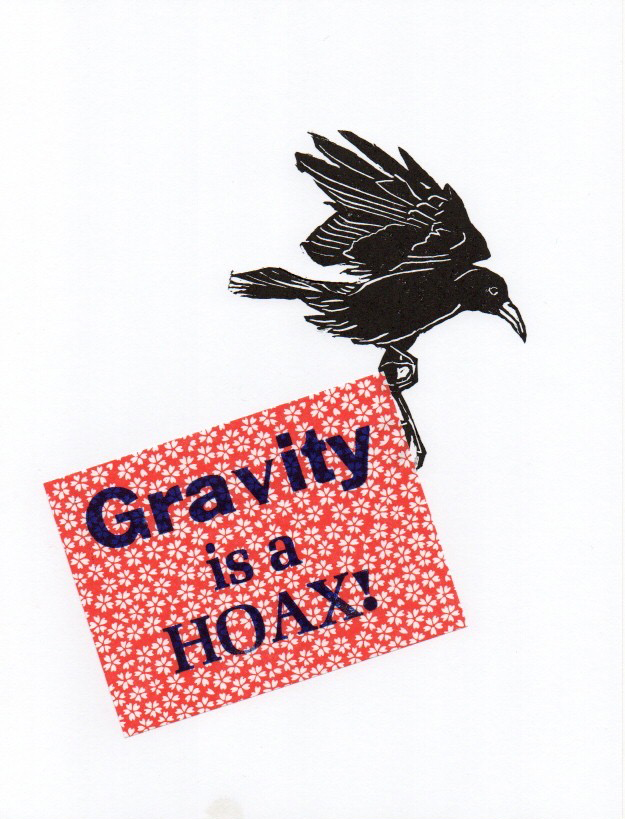
If you attended the Anna Templeton Christmas Tea & Craft Sale, you might have seen my latest campaign “Gravity is a Hoax!”
Okay, I know this is going to be a difficult sell but (and this is only because I am a woman of great conviction and resilience) I am willing to fight the good fight.
I have two solid fact-based reasons in defence of my position.
Number 1: Gravity is a hoax, because I don’t believe in it.
And neither did Einstein. (He thought it was all relative.)
Newton was a junk scientist. That’s just a fact.
And (Point B): Nature Doesn’t Lie.
Look at the birds in the sky. They don’t know about gravity. Maybe if we didn’t listen to Newton, we could fly also.
At the tea and sale, this past November, I sold one of these to a physicist. She was going to hang it in her office at Memorial University of Newfoundland. She agreed with me! That’s a solid endorsement.
I was also surprised by the two people who tried to convince me that gravity is not a hoax, but is a real thing. One, a woman visiting from the West Coast, had encountered members of the Flat Earth Society. I admitted to her that I have a soft spot in my heart for those people. This only made her exhort with me all the more passionately.
The other man had read an article in a popular science magazine about the Hubble telescope…I think. He was an older gentleman, and he was quite concerned that I stand corrected in my fallacy. I don’t remember much about his argument, but it had something to do with Stanford University’s really long accelerator lab? I only remember that part, because when I taught in a Silicon Valley parochial high school, me and my friends would rollerblade in the park above SLAC. It was fun. And no, I wasn’t teaching physics.
It is so reassuring to me that there are at least two people in this world who care enough about my sanity, that they will debate with me about something so patently ridiculous. Human kind indeed. An amazing species, when you think about it.
I came up with my new campaign after reading (now) Prime Minister Mark Carney’s book Values (2021) where he described Greta Thunberg’s confrontational speech to the UN Climate Action Summit (2019). “Her determination lays bare the imperatives of climate physics…” (Carney 275).
Calling climate change science a hoax is as ridiculous as calling gravity a hoax. But still, that’s what President Trump said last week at Davos. You can be excused for not noticing. He says a lot of things. It really has come to a point where we all need to stop listening to him. Which is basically what Carney said at Davos the day before.
(Also you need to read Values. And underline it. And, if you’re Canadian, hold Mark Carney to his values.)
My point is: when going downstairs to the toilet tonight (another physical imperative, only this one is brought on by my bladder) if I slip on those stairs, it really doesn’t matter whether I believe in gravity or not.
I don’t think I’ve changed much since 1985 when a seminary professor challenged us with this question. The class was titled “Youth Ministry” and Dr. Steve Case described how for many teenagers, life is riding a sinking canoe in the middle of a swift river. Adults can stand on the bank, throw a rope, run for help, or watch.
“Where are you standing?” he asked us.
“I’m in the canoe,” I said. (It was more of a seminar than a lecture.)
“You’re in the canoe!” Steve looked at me, his eyebrows arched in incredulity at my arrogance.
“I didn’t say I had a paddle!”
One year from the October 7th massacre of Isreali civilians, with no end in sight to the revenge massacre of Palestinians and, now, Lebanese civilians, I feel helpless. I have been a faithful witness this year. I have read articles that minutely described the violence perpetrated on Jewish bodies. I have read personal accounts of the suffering of Palestinian families. I have been shocked at the brutality of a Hamas youth shooting an infant at point blank; I have been shocked at the brutality of IDF soldiers shooting three unarmed Isreali hostages, stripped to the waist, and waving a white tee-shirt in hope of rescue from their Hamas kidnappers. I am outraged at atrocities enacted by Israeli state-sponsored terrorists upon Palestinians in the West Bank, while the rest of the world is distracted by Israel’s carpet bombing of Gaza. And, all while I am outraged at the Israeli military actions, I am very aware that there are twenty-five military communications Israeli women who were kidnapped from their bedrooms in the early morning of October 7. If any of them are still alive, they are suffering on-going brutalizing torture as I write this.
There’s a phrase that has been quoted a lot this year: “Silence in the face of injustice is complicity with the oppressor.” This was written by the late Ginetta Sagan, an anti-Fascist partisan who put her life on the line in Mussolini’s Italy. Sagan survived the rape and torture of the infamous Black Brigade and went on to become a leader in Amnesty International.
I have been silent this year, and last month. It has taken me a month to post this essay, in fact.
A few years after that Seminary class I was teaching world history in a small school in Yorkton, Saskatchewan. In the 1980’s textbook I was using, the Holocaust was covered in a sidebar on World War II. It was almost an afterthought: “Oh, and by the way, six million Jews were murdered.” Throughout my teaching, I attempted to redress that silence. Over time the textbooks expanded and my resources grew, until, in my last job (twenty-four years ago) I was able to take advantage of the local Holocaust Memorial Speakers’ Bureau, and invited a survivor to speak to the school.
I’m afraid I don’t remember her name, but she was wonderful. Strong in a scary old-woman way, she was tenacious and sinewy. After introducing her, I sat in the front row. But I was mortally offended to see one of my students falling asleep. I leaned across the aisle and poked him awake. Afterwards our speaker said to me, “Let the children sleep. My story is a hard story. The Nazi’s wouldn’t let me sleep. So, I always say, ‘Let the children sleep.’ I am going home now and I will sleep. This is how I do.” I was ashamed to have tried to control my student, to have acted like a fascist in my zeal to force him to emphasize. That same day the boy told me, “I wasn’t sleeping Miss, it was so hard, I had my eyes closed, but I heard everything she said.”
His silence was not complicity, it was empathy.
But empathy is not action. Especially if empathy leads me to lash out like a traumatized child, controlled by her amygdala, unable to reason or be reasoned with, impotent with rage.
I was fourteen when Saigon fell. At the time I thought that all adults who did not wholeheartedly support the Vietnam Peace Movement were right-wing totalitarians. But, this summer, when I saw a woman, anonymous in a black burka, wearing a PLO scarf and yelling slogans in a bull horn, lead a parade down Water Street, I thought: Oh, so this is how those adults felt.
Thoughtful adults, who paid attention to the purges of Stalin in Russia and Mao Zedong in China, expected a brutal bloodbath in Vietnam. What was the humane thing to do? Worst atrocities happened in neighboring Kampuchea under the Khmer Rouge. But, coming immediately after the American evacuation of Saigon, the brutal state-sponsored murder of 2 million Cambodians continued for four years without any outside intervention. When I lived in Thailand in 1980, I was told that the Cambodians were so brutalized by the Khmer Rouge that they welcomed the Viet Cong with open arms.
Survivors of the Cambodian genocide said that it was the child soldiers that they feared the most. The children with “dead eyes” had absolutely no compassion or empathy. They did not respond to reasoning or pleading. They killed without a conscience.
Child soldiers will be the product of the bombs on Gaza. They are the teenagers who celebrated shooting children, women, and unarmed men on October 7.
I am rewriting this essay on November 11, Remembrance Day, when the Metrobuses in St. John’s have the words “Lest We Forget” displayed in lights.
Where am I standing on Israel’s war against its own citizens in Gaza and the state-sponsored terrorism in the Palestinian West Bank? Where do I stand on the violence of Hamas against Israeli citizens? I support an arms embargo, and I believe that Israel should have a free and democratic election. But these are my opinions, I have no more power in Israel than I had in the recent U.S. election. I can make posts on my social media, I can send what little money I have to Doctors Without Borders, but I’m not saving any children.
So, I stand on the river bank. I watch. I do not look away. I will not forget.
But it feels like complicity.
(This is not the essay I was planning on writing. For a better, more analytical article about art around October 7, I recommend Naomi Klein’s essay in the October 5, 2024 edition of The Guardian. Provocatively titled “How Israel has made trauma a weapon of war” Klein asks her readers “What is the line between commemorating trauma and cynically exploiting it?” It’s a great question. One that concerns an artist like me, who is currently working on a graphic long-form non-fiction about the torpedoing of a Newfoundland ferry on October 14, 1942. Maybe I’ll write about that in my next blog post.)
“I’m expressing this visually,” I argued with my professors, “Why do I have to write something down?”
I thought that writing my thoughts killed the art. If I expressed the idea in words there was no reason to say it visually.
My residency with the Association for the Arts in Mount Pearl ended and I moved “Reframing the Grimm” out of the Annex in March 2024. Since then I’ve been pitching this artwork to granting organizations, galleries, shows, even a convention, and I’m writing a lot of art statements. It’s a job that I now enjoy —not that I’m good at it, but because it challenges me. I write and rewrite art statements for each application, sometimes to fit the new context, sometimes because this artwork keeps changing.
When I write these statements I’m asking myself: What am I saying? What was important enough to make me want to say this? And, what makes this a “Jennifer Morgan” piece of art?
Robert Chafe says that when a story makes him cry, he knows he will write a play about it. Mary Pratt said she “felt a zing” almost sexual, when she saw the light hit an object. In my case, I feel a longing when I see a photograph, or a collection of houses, or a cove placed in a bay, like it was painted inside a teacup. But that feeling doesn’t make an art statement. What are the things I’m attracted to? What are the ideas I end up returning to in woodblock, etching, or in paint?
I create art to understand things around me. Drawings are often called studies. Like other things I have studied, I feel a special affinity for people, places, and objects that I have drawn. I know them (as Mary Pratt might say) in the Biblical sense.
Two years into this project, in the midst of a painful relationship crises, I realized what this piece of art was saying. It was about patterns of behavior that I saw myself repeating, patterns that I thought were protecting me, but which were really hurting me. Once upon a time, I thought this artwork was about the Grimm’s fairy tale “The Juniper Tree”, but that story is completely immaterial to the real theme of this work of art. It only gets credit for getting me to the final goal.
This past March, when people showed up at the Mount Pearl Annex and embodied this labyrinth of bad relationships, I saw the meaning of my immersive book change–again. In the heart of the labyrinth each reader enters a triangle, made up of the back of the printed story, with signposts that read: You Belong; Yes, I Can; and You Are Enough. Here, I reversed the stereotypical roles with “Coach” in gold letters above an upside down “Hero”. Likewise, “Victim” was supplanted by a gold “Risk-taker” and “Challenger” (also in gold) overturns “Bully”. These stereotypes form the three corners of a diagram created by the psychiatrist Stephen B. Karpman, which he called the Karpman Drama Triangle.
Then there are the three meditations hanging in each corner. One is a quote from the Gnostic gospel “Voice of Thunder” the other two are written by me, but inspired by the Gnostics. A Christian sect, influenced by nature mystery religions, the Gnostics believed that wisdom was found in the clash of opposing thoughts. Rather than “either/or” they believed in “both/and”. And, that brings us to the centre, the core of my immersive book. Here in the centre is engraved a little boy in a fetal position, playing a video game on his phone. He is engraved in a tree slice which rests on a pile of books.
This is not a piece with a lot of answers. But there is one thing that I know is true: the most important thing must be the child, everything else is negotiable. The three egos in the three corners of every story we’ve ever triangulated are interchangeable. They are figments of our imagination—which is not to say they are not powerful. That was my meaning of the piece. But every reader came away with a different message. I know because I asked them, and then, the asking became the theme of this work.
In March, I sat in the lobby of the Annex, and listened to people answering my five feedback questions. The last one was, “What did you feel in the centre of the triangle?” Some people felt claustrophobic, some felt peaceful, one felt sad, one felt awed. Four people had gotten lost in the maze and I interrupted our interview to show them where the middle of the triangle was. After that I hung a sign which said “Exit this way”.
“But there was no exit!” two readers complained.
“So how did you exit the triangle?” I asked them.
Some people ducked under the pattern paper, some people retraced their steps. Nobody took down the walls, which I did with the help of the Nia dancers, radically restructuring the story. I’m both relieved and disappointed that no one took my artwork apart.
The point is, the story was just a vehicle. The message of the artwork was in the conversations I had with everyone who came to see my art.
Here’s my new Art Statement: ‘Reframing the Grimm’ is a way for me to get to know my readers better. They are the subject of this work of art.
Now, when I’m out and about in St. John’s, and I see my readers, I feel the same affinity for them that I feel for subjects I have drawn. They honored my artwork with their attention and, in return, allowed me to see them and hear them.
His official name was Joseph R. Smallwood, but his boyhood friend and my grandfather, Mac Morgan, called him Joey. By the time Newfoundland joined Canada, almost forty years later, everyone in the country also called him Joey.
Mac and Joey met in the busy business district of St. John’s, the capital of the Dominion of Newfoundland. They were both the same age as the year, so this would have been around 1912 and they sold newspapers outside the tobacconist on Duckworth Street to lawyers running to Court and businessmen buying pipe tobacco.
Joey, a boarding student at Bishop Feild, picked up his papers after school from either The Evening Telegram or The Daily News, or one of the weekly papers. Today, St. John’s has only one newspaper, The Telegram, a thin publication that is printed six days a week. In my grandfather’s adolescence the town had at least two dailies, and several weeklies, often five or six newspapers, each representing different sides of vigorous debates on a wide range of civic issues.
While Joey came from rural Newfoundland, Mac was a townie who, after attending the small Seventh-day Adventist school run by Miss. Pippy, took his grade eleven at Prince of Wales Collegiate – the preferred alma mater for Protestant merchant class scions. It was unusual for sons of tradesmen to finish high school, Mac’s friend never did, instead Joey parlayed his contacts as a newspaper boy and, I suspect, typesetting skills learned in the basement of Mac’s family’s house, into a job as a Printer’s Devil for the Plaindealer.
A Printer’s Devil is what they called apprentices who cleaned the shop, melted yesterday’s articles into lead slugs for tomorrow’s linotype, and sorted headliner type back into a job case. By 1919 Joey had worked his way up to being a cub reporter at the Evening Telegram accompanying Billie Murphy to Trepassey to cover the first successful (but not unbroken) crossing of the Atlantic Ocean by the Americans. He even had his own byline on an article about the Naval Wireless Transmission Station in Mount Pearl, currently home to the Admiralty House Communications Museum, next door to the Annex where I’m doing my art residency this winter. Joey used his Evening Telegram portfolio to get reporting jobs when he moved to New York the next year.
Family lore says that when he first arrived in the Big Apple, Joey slept on the couch of his friend Billie Newhook, who was courting Mac’s sister, Cynthia Morgan. Cynth married Bill in 1922, which may have forced Joey to find a place of his own. At the time he was a freelance journalist for at least three New York newspapers.
In the post-war era most New York working class intellectuals were socialists. In 1924, Joey worked on the Socialist Party of America’s presidential campaign, while writing for the socialist paper The New York Call. When he returned to Newfoundland, Smallwood imitated his hero, Sir. William Coaker, becoming a union organizer and founding two newspapers: the Labour Outlook, and then the Humber Herald. He was living in Corner Brook at that time with his new wife, Clara. He also joined the Liberal Party (again, like his hero Coaker) working as campaign manager for Sir. Richard Squires in the Humber valley, and running, unsuccessfully, for Bonavista a few years later.
I don’t know if it was politics, or geography, or just the busy life of a job printer with a growing family, but Mac lost touch with Joey. Then, everyone in St. John’s was reading a column in the Daily News called the Barrelman.
The Barrelman is the sailor stationed in the crow’s nest. He is the first to sight land, or danger, and to communicate that to the crew. In his column, Joey Smallwood took advantage of his personal knowledge of the island to promote (he would say create) Newfoundland nationalism.
When the Barrelman appeared on radio VONF (the Voice of Newfoundland) in 1937, Joey’s fifteen-minutes of patriotic anecdotes and cultural gems became required listening across the Dominion. But the Depression was in full force in Newfoundland and, needing to support his family, Joey returned to his birthplace in central Newfoundland to run a pig farm.
But Newfoundland didn’t forget Joey and, when he left the farm to enter the confederation debate, Joey remembered the power of radio. As the Barrelman, he had developed a relationship with his listeners by reading their letters on the radio. He had his generation’s trained memory, and never forgot the name of anyone he met. He had the gift of persuasion, the ability to read the room, and he told stories that pulled on people’s heartstrings. His speeches were not wordy treatises, written to be read, but filled with repetition and short sound bites. Joey Smallwood wrote for radio.
But it is interesting that in this, the fight that history remembers him for, Joey also created his last newspaper: The Confederate. Why would he do that? Maybe it was because radio was ephemeral. In that era words on paper built credibility and legacy — especially if you controlled the medium. Or maybe it was that newspapers were something that Joey understood from a lowly Printer’s Devil up to being a newspaper publisher. And yet…Joey had witnessed radio’s power during the Depression, when populist politicians used radio to win elections in the United States and Europe. In World War II, like everyone else, Joey heard Winston Churchill use radio to rally the Western democracies against Nazism.
I suspect that the St. John’s Protestant merchant class never tuned into VONF, or attended rallies in the small towns where fans showed up to meet the Barrelman. The final vote was 51 to 49 in favour of confederation. Some say the referendum was rigged. But, even if that is true, rural Newfoundland and working-class St. John’s and Corner Brook, showed up in strength to vote for Joey.
The photograph above, also on display at Admiralty House Museum, shows Joey Smallwood signing the agreement that made Newfoundland a province of Canada. The museum caption says that Joey barred all members of the press – with the exception of radio – to the event. What the newspapermen didn’t hear, when the sound of Joey’s signature was broadcast across the country, was the cry from the Barrelman signalling the death of print media, and the arrival of radio. The day was March 31, 1949.
This morning I woke at 4:15 with a massive case of Imposter Syndrome. I blame it on reading Tom Hanks’ book, The Making of Another Major Motion Picture Masterpiece and the beginning of a three-month-residency at the AAMP (Association for the Arts in Mount Pearl) Annex. For frig sake, I don’t even live in Mount Pearl.
This project is clearly outside my area of expertise. I am not a performer. Coaching high school drama without any training or experience, doesn’t make me eligible, in fact quite the opposite. As Mark Twain said “if you can’t do something, you can criticize” and my father would add “and if you can’t criticize, you can teach.”
In Hanks’ novel, a writer-director at the top of his game chooses to work for a franchise (which he hates) to create a comic book motion picture (a genre which he dismisses). In his novel (which I thoroughly enjoyed) Hanks takes us through every step of making a movie, from Source Material to Post Production. I believe that Tom Hanks does not intend to make an unknown Newfoundland visual artist wake up in the early morning with Imposter Syndrome. In fact, most of his many point-of-view characters enter “the Cardboard Carnival” with little or no formal theatre arts training. So, I shouldn’t feel unqualified…especially since I’m not making a movie.
Meanwhile, in a large empty room with theatre lighting in a bedroom suburb outside North America’s most easterly city, a letterpress artist has decided to create an Immersive Book. She doesn’t know what an Immersive Book is. When explaining it, she references haunted houses, although she has only ever walked through one haunted house in her life. There are a lot of things she doesn’t know.
There is, apparently, a Thing called Immersive Theatre. The fact that I didn’t know this, and that I had to have another artist explain it to me, only exacerbates my insecurities. Plus, after reading Tom Hank’s novel, I realized that theatre arts is a Real Thing, and there are Important People who are Paid a Lot of Money to Work Hard in this Multimillion Dollar Industry. And then, at the other end of the spectrum, there is Jennifer Morgan who, ever since she was a child wanted to make a book that you walked into. (Thought to self: Why do I keep falling into the second-person in this diary entry? And is it true that only homicidal narcissists talk about themselves in the second-person? She wonders.)
In Creativity Inc. Pixar co-founder Ed Catmull writes that creative people, like the Roadrunner cartoon, are laying down the train tracks, while driving the train. In order to create new things, we have to figure out the engineering required to meet our goals. I had no idea that my childhood goal of creating an immersive book, would lead my visual art to intersect with theatre. Dramatists are the engineers that have already figured out how to lay down the train tracks I need.
So, members of the ArtsNL jury, I stand before you, a lowly visual artist, alone in a large empty room, which I am filling with artwork that I am completing even as I write my next grant application. And no, I am not trying to mislead you by applying for a visual arts grant, when it is clear that 3/4ths of my budget will pay theatre arts professionals to animate my art installation. Yes I have a script (which badly needs dramaturgy—a fancy word I learned that means editing for stage) and yes I want to mount this play, but that doesn’t make my artwork a set, or me a playwright. Well, maybe the latter, because the existence of a play implies a playwright, but still, believe me when I say, this is Visual Art, just not mind-numbingly obscure, because, why can’t visual art be fun also?
(At this point the artist notes that it is twelve hours since she woke up in the early hours or this morning, and she has not had the nap she promised herself, ergo she is not thinking as coherently as she should be.)
On my first week of residence at the Annex, I brought a bunch of second-hand books that came from the Friends of the Library. I’m not supposed to tell you this, but libraries throw away a lot of books all the time. Books are donated. Some the library already has, some are added to their collection, and some they sell at fundraising book sales. They only have so much room for the leftovers. So I got a random collection of books to use as ballast for my Immersive Book.
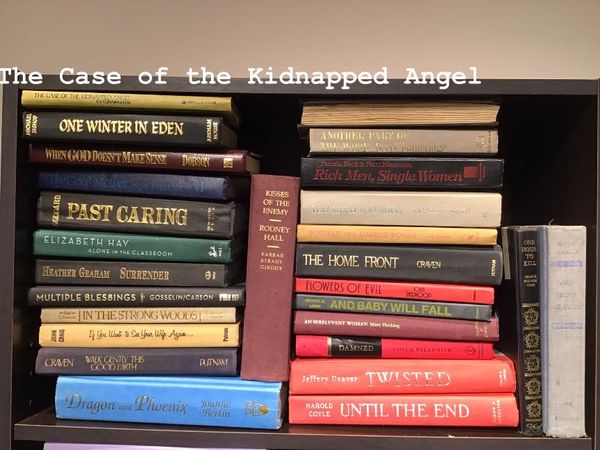
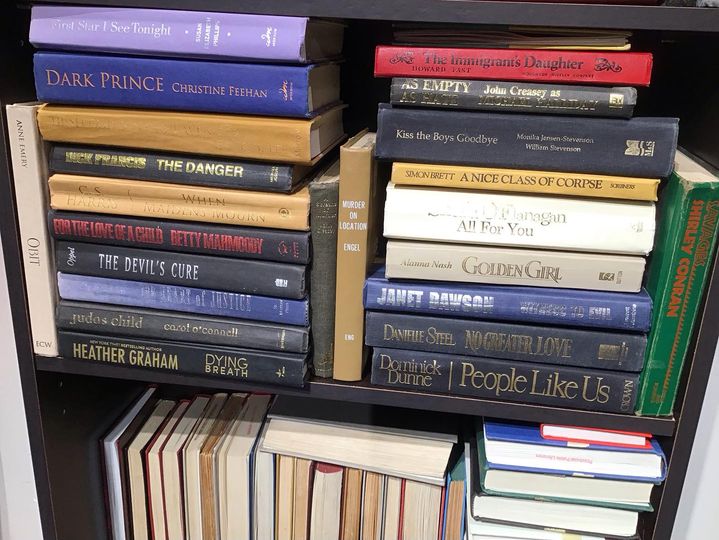
Last week, moving the books into the Annex, I started reading the titles. And then I started sorting them according to interesting titles that related to the subject of my Immersive Book. And then I created the Book Title Poem in the photograph at the top of this blog. I’ve typed it out and pasted it below.
To me this poem is talking about the abuse that is subtext, and the child murder that is in the text of the Grimm’s fairytale, “The Juniper Tree.” I’m not sure if “Book Title Poems” are a thing or not. I know that I’m not a poet. I just want to turn this story around in my head, look at it from different directions, using different media, and then I want to illustrate it, or to comment on it. Because that’s my job as a visual artist. I create art that makes you look at the world differently, that helps you see things you didn’t see before. And that’s what I’m doing in this residency, with my Immersive Book.
–Jennifer Morgan
The Case of the Kidnapped Angel
I.
One winter in Eden, When God doesn’t make sense, The Good Mother Alone in the classroom, Surrender Multiple blessings In the strong woods. “If you want to see your wife again… Walk gently this good earth, Dragon and Phoenix.”
Kisses of the Enemy, Another part of the wood, Rich men, single women, Too much too soon. Portrait of a married woman: The home front flowers of evil And Baby will fall. An irrelevant woman, Damned, Twisted until the End.
One hour to kill Fire from Heaven.
II. Obit.
First star I see tonight, Dark Prince, The second son of Heaven. The danger When maidens mourn For the love of a child. The Devil’s cure, The heart of justice, Judas child, Dying breath.
A scream of murder, Murder on location.
The immigrant’s daughter, As empty as hate, Kiss the boys goodbye. A nice class of corpse, Sheila O’Flanagan, All for you, Golden Girl, Witness to Evil. No greater love People like us, (Savages.)
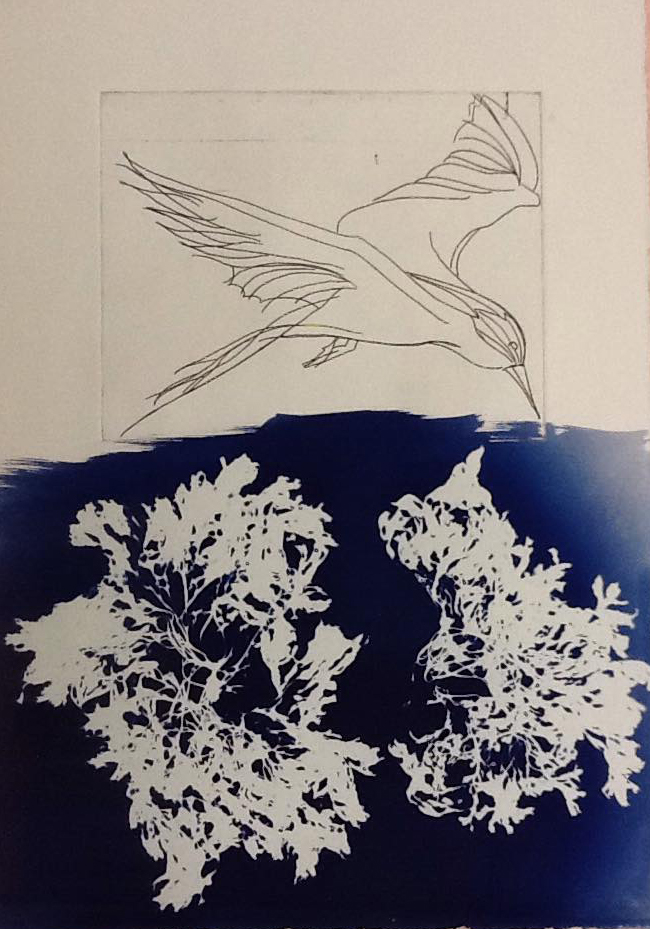
Don McKay is a poet who is fascinated with geology. I am a printmaker who loves using the old letterpresses at the Coaker Foundation’s Advocate Press. Because Port Union is home to an exciting fossil, Haootia Quadriformis, and because fossils are a kind of print, I suggested to Don that he write a poem and I create a print about it. The result was a collaboration that was launched on Thanksgiving Day weekend 2019, at the Coaker Foundation’s Factory in Port Union and Little Catalina. The image on the right, “Tern and Seaweed” was created for the first stanza of Don’s first poem, and is an etching and cyanotype combination.
This is a reposting of my October 2019 announcement of the project’s celebratory launch. The artwork from this collaboration can be seen on the Craft Council of Newfoundland & Labrador’s Gallery website for the show: PreCambrian Braille. (click)
Don McKay: Don’s writing has been marked, for the last few decades, by an interest in geology and deep time. This is evident in books of poetry like Strike/Slip and Paradoxides (NTS) and books of essays like Deactivated West 100 and The Shell of the Tortoise (Gaspereau). He has a great deal of experience teaching creative writing (Western University, UNB) and editing (Brick Books, The Banff Centre, Piper’s Frith). For this project with Jennifer Morgan, he has been concentrating on fossils (eg. Haootia quadriformis, Aspidella terranovica) found on various sites on the Avalon and Bonavista peninsulas.
Jennifer Morgan: Jennifer has illustrated seven books, including the graphic novel Almost Home: the Sinking of the S.S. Caribou (Breakwater, 2012) which won the Heritage and History Award for Young Adult writing. In 2015 Jennifer was a resident artist in the Coaker Foundation’s Advocate Press. Since then she has used every excuse she could find to create art in this space. This past spring Jennifer founded the Advocate Guardian program, where artists who have been in-serviced on the press can use it on a drop in basis in season.
I’ve just dropped these paintings off for the opening a figurative art show at the Red Ochre Gallery.
People who know my work will recognize these stamps from my prints inspired by postcards. But, unlike my woodblock engravings, I decided to play around with these paintings, and not try and replicate the original stamps. I’d like to thank Christine Hennebury for this spirit of playfulness, since she invited me to paint a traffic box in Mount Pearl. Also Christine is a writer who approaches her art with humor and fun.
I couldn’t control the shape of the traffic box. So I decided to paint the Queens Victoria and Mary, wrapped around the box. I asked for a corner of Commonwealth Avenue, because I loved the idea of Queen Victoria in her widow’s weeds, sadly looking down that busy street.
The five days I painted turned into a performance art piece for me–people slowed down to give me a thumbs up and call out greetings and compliments. (Who knew Queen Vic was still such a popular gal?) I posted on my FaceBook page “Barmp if you like art!” And people did.
This time, while I was painting Queen Victoria, I started to see a rocky “Gerald Squires” landscape wrapped around the bottom text. I guess I was asking myself what made this postage stamp a particularly Newfoundland image. The final piece, “Queen of Newfoundland” is a homage to Gerald Squires, whom I took three classes from in the eighties, and who granted me an interview for a show he had in the early 2000’s. Since he died last fall, people have said a lot about him, but I haven’t heard anyone say what a courageous artist he was. Squires painted in failure. He painted in success. He painted in poverty, and, just when you thought he was finished, he would throw on a muddy wash. Vermilion rivulets covering the woman’s face. A dirty rag picking out the highlights. And it was perfect!
When I took the portrait class from Squires, he had his friend, and Evening Telegram art critic, James Wade pose for us. On the first night I covered a large canvas with phthalocyanine green. Then I painted an absolutely brilliant portrait of Wade in golden umbers. For the rest of the month, I would show up once a week to spend a miserable evening adding flesh tones and scraping everything off. I never recovered that first golden painting.
At one point Wade, who was dying of cancer at the time, standing by my quietly bleeding painting, said, “I’d like to write about your painting in my column.”
I glared at the poor man, “Don’t. You. Dare.”
And he didn’t.
I thought of that painting, when I tried to pull King James out of a Prussian blue background. Once again, my fallback WASP skin mixes, were not working. So I scraped everything off, and started an ochre underpainting. Gradually I lightened the tones, one layer at a time. At one point I had the Scottish King looking like a light-skinned African American, and I was tempted to leave him there. But this painting wasn’t about race. So, I brought his face up to that pasty yellow colour we honkies call skintone.
I’m thinking of this painting as an homage to my other early influence, abstract expressionism. (New Yorker cartoon from the nineties showing a group of people sitting in a circle, “Hi, my name is John, and I’m an Abstract Expressionist.”) I’ve just been to a wonderful show at the Bonnie Leyton Gallery by John McCallum which has reignited my love of raw, emotive, abstract expressionism. McCallum, a furniture maker and construction worker in his day job, uses shaped canvases and glues everything on in unrestrained creativity. I loved his landscape showing Harbour Drive and James Baird’s Cove from the Atlantic Parking Garage. Right at your “feet” the viewer sees actual roofing tiles stuck on the painting. In addition to being fearless, McCallum is a really strong draftsman, capturing a figure with a few deft strokes, and a room with minimal but accurate perspective lines.
Hence the addition of the rope. That was a good idea borrowed from McCallum.
All my Newfoundland stamps owe a credit to Christopher Pratt. And, Andy Warhol, who reproduced Campbell’s Soup cans. And Bill Rose, who has been combining American Pop Art with Newfoundland imagery throughout his career.
So these are two fun pieces, that celebrate my personal art history. “Barmp if you like art!”
I’ve been very quiet on FaceBook lately and my promise to keep a blog for 2015 has fallen by the wayside. However, I am taking a course in my master’s program at Mount Saint Vincent University in Media, Culture and Society. I thought I would post the journal entries that I have been submitting. This was submitted on January 20, 2015.
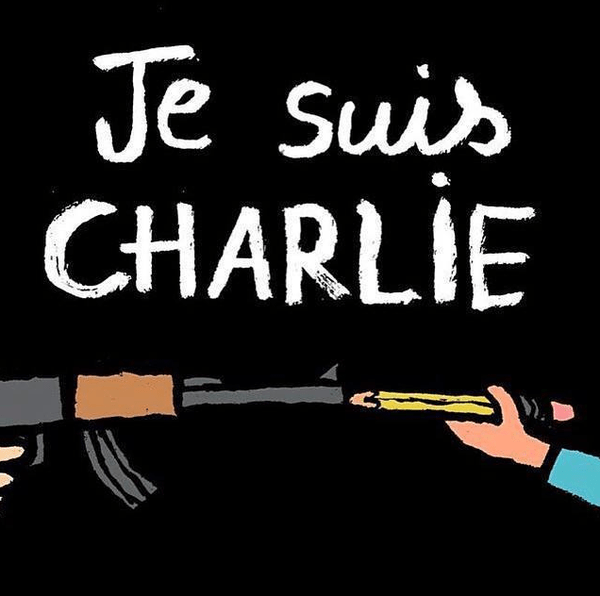
Fourteen years after the Al Qaeda attack on the World Trade Center, I still don’t understand Islamist terrorists. These last few weeks, while I was reading about communication theory and society, I have also been trying to understand the attack on the French satirical magazine, Charlie Hebdo, and the aftermath that lead to the death of seventeen victims and three gunmen. Somewhere in my media bath that week, the phrase “conflicting narratives” attached itself to this event. This essay is my attempt to parse meaning from the actions of Wednesday, January 7th and the week that followed.
First I had to reject my preconception that the medium of the Arab Spring, Al Qaeda, the Islamic State of Iraq and Syria (ISIS) and Boko Haram is the Internet. In his first chapter of “Understanding Media” (1964) Marshall McLuhan explains that a night time baseball game is possible because of the electric light—therefore the light is the medium and the baseball game is the content. The content is a “matter of indifference”—it could be a baseball game, it could be brain surgery. What is important is that human association and activity has happened because of the electric light (McLuhan 8). Federman, in his very helpful essay “What is the meaning of the medium is the message?” defines a medium as anything from which a change emerges. That change in human association and activity is McLuhan’s message.
After the killings at the Charlie Hebdo office, Western media drew attention to the cartoons in that week’s issue of that magazine. Media panels debated both sides of the perceived issue: freedom of press versus offensive content. But the content of the Charlie Hebdo magazine was a matter of indifference. The medium that the Islamist terrorists used was violence, and the message was the reaction to that violence in the Western world.
In The Telegram (St. John’s, Newfoundland) columnist Gwynne Dyer said the Paris gunmen acted out a sophisticated strategy as part of a Muslim civil war over modernity. Despite the innocent people killed last week in Paris, even adding seven thousand killed in New York and victims in London and Bombay, the overwhelming majority of deaths in this civil war are Muslims killed by other Muslims. The message of the attack on Charlie Hebdo was not to “terrify non-Muslims into submission” (Dyer 2015). The message was the reaction of the West to that violence.
Islamist terrorists include many groups that disagree with each other, but are united in their disapproval of modernization in the Muslim world. Unfortunately, for the terrorists, most Muslims like modernity. Violence outside of the Muslim world, in Paris last week, is not to send a message to Westerners but to modernized Muslims. Islamists claim that democracy, free press, and Western education, are acts of colonization. An attack on a Western target triggers Western military invasions into Muslim countries, proving the jihadi contention that modernity is a Western plot (Dyer 2015).
I don’t want to minimize the deaths of seventeen innocent people. But this event perfectly fits the four characteristics of what Daniel J. Boorstin called a “pseudo-event”.
It was not spontaneous. On the evening of the shooting a security expert on CBC’s The National, with nothing but an amateur video to analyze determined that these were professionals acting on a plan.
It was designed for reproduction. One of the three gunmen, Cherif Kouachi, gave credit to al-Qaeda in Yemen, in an interview with a journalist (IBT 2015). This interview was taped during the hostage taking. A video was released two days after the death of Amedy Coulibaly, the gunman in the Paris kosher supermarket. In the pre-recorded video Coulibaly pledged allegiance to ISIS (CBC News, January 11, 2015).
Both released statements had an ambiguous relationship with reality. “We are not killers! We are defenders of the Prophet,” Kouachi told his interviewer. (IBT 2015) In real news events journalists tell us what happened, but reports of Coulibaly’s video and Kouachi’s interview explored motive and their conflicting claims of allegiance. Like all media releases, the content of their press statements was predictable and of little interest to Western audiences.
The attack on Charlie Hebdo was a self-fulfilling prophecy. The cover of the next issue of Charlie Hebdo was a cartoon of the Prophet weeping with the words “All is forgiven.” In the Western narrative this was a gracious response, showing how the true Mohammed would feel about the killings. Western media largely represented the event as an attack on the freedom of the press, but modern Muslims were the targets of the violence. Modern Muslims were not reconciled by the cartoon image of the Prophet, but were offended and it placed them in a difficult position. The jihadists accused the West and modern Muslims of blaspheming. By representing the image of Mohammed, Charlie Hebdo showed that the jihadists were right, and any Muslim who said “Je suis Charlie” was demonstrably a blasphemer. It could be argued that the terrorists designed Charlie Hebdo’s cover cartoon.
In a sense all communication is a crude caricature, a clumsy attempt to say who we are and what we value. As our technology grows lighter, our world shrinks, our social contacts grow and our messages can be misunderstood by, and offensive to more people. The Islamist terrorists have discovered how to use media to create social change. But we need to understand more than how to use the media. We need to know when we are being played, and not continue to give violence a positive feedback loop. In a media-saturated society, we need to learn how to control both the medium and the message. Events like the attacks in Paris are recruitment tools attracting Western-raised and educated youth to join the Islamist terrorists. The West is in danger of losing a communications battle over the hearts and minds of modern Muslims because we don’t know what we are saying.
Boorstin, D. (1961). The Image: A Guide to Pseudo-Events in America. New York: Random House.
Dyer, G. (2015, January 17). “There’s a strategy behind the Paris attacks.” The Telegram. p. 18A.
One night my mother-in-law dreamed that she was standing in a crowd waiting for Clint Eastwood to pass.
When he walked by she called out, “Hi Clint! Remember me? I’m Jean Baltzer. George and I used to work for you at your ranch.”
And Clint said, “Hi Jean.”
I thought the dream was sad, but Jean seemed happy that Clint said hi to her.
“He was always real friendly,” she said.
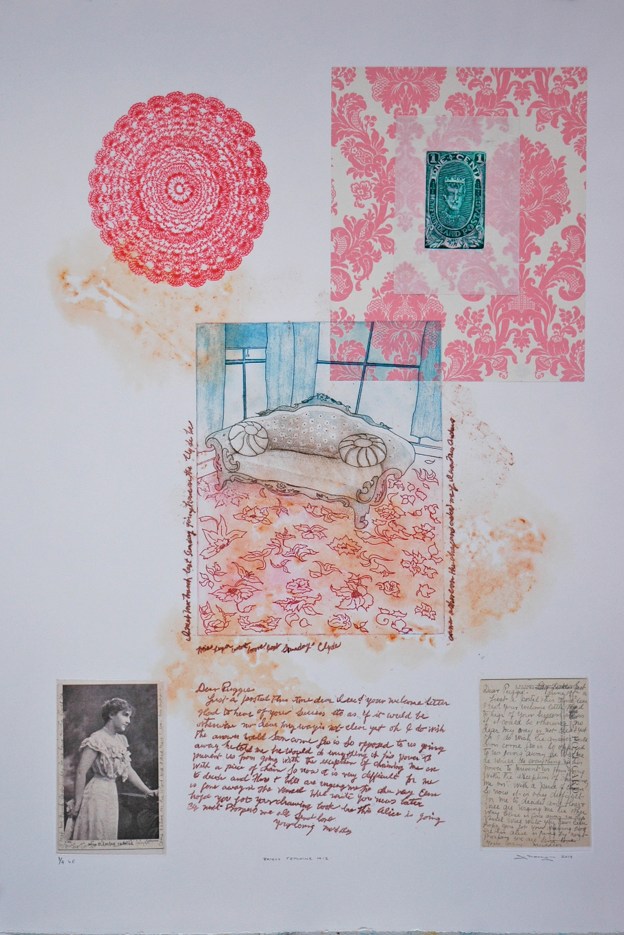
The postcard in this collage was one of the early examples of celebrity culture. Neither E.L. Martin who wrote this postcard, nor her friend Emma Morgan, nicknamed “Puggie”, would have seen Miss Ellaline Terriss on the London stage. And this postcard was mailed a year before Ellaline Terriss’s first silent film. But Ellaline’s strength after the murder of her famous father, her marriage to another actor, and her raising two daughters, were all sympathetically covered in contemporary newspapers. Shown with a creamy complexion and the cinched waist of the Edwardian lady, Ellaline appears the model of womanhood.
The text on the postcard shows a less dramatic life with a very common dilemma. “No dear my way is not clear yet,” writes E. L. Martin aka “Muddles”. “Oh I do wish the answer would soon come. Geo. is so opposed to us going away he told me he would do everything in his power to prevent us from going with the exception of ‘chaining me on’ with a piece of chain. So now it is very difficult for me to decide and Floss & Will are urging me the other way.”
The domestic interior in this collage shows the living room in Hawthorne Cottage, home to the mother and two sisters of Captain Bob Bartlett. They called this room “The Arctic Room” and filled it with photographs of Bartlett with famous people, apparently to promote his celebrity status. Ironically the Arctic Room is also covered in feminine flowers including the linoleum floor and the woodwork on the couch. Through the Great Depression, these women ran a farm and a teahouse, and struggled to maintain their cottage in style. The Arctic Room speaks to me of how hard women have worked to keep up appearances and meet external standards.
From the perspective of time, I am more curious about the domestic concerns of Muddles than the story of Ellaline Terriss. But any photo of E.L. Martin has been lost, and we are left with the image of celebrity. In the same way the Arctic Room doesn’t show us the turn-of-the-century lifestyle of the average woman in Conception Bay North, but the contemporary decorating fashions in London and New York. I don’t mean to be critical of the aesthetic choices of either the Bartlett women or Muddles. I thought that by framing their choices I could direct our attention to the women behind these images and the feminine ideal that shaped the lives of rural Newfoundland women in 1912.
My cousin Jennifer Morgan and I are doing an artist talk together this Wednesday evening at the Red Ochre Gallery here in St. John’s, where Jennifer has an exhibit of prints based on the same collection of Coley’s Point postcards that inspired my book That Forgetful Shore (enough links in that sentence fer ya?). We were interviewed on CBC Radio’s Weekend Arts Magazine about it, and I put together this video of the postcards and some of Jennifer’s prints to accompany the audio of our interview. Hopefully it gives you a little foretaste of what you’re doing and perhaps, if you’re in the local area, you might want to drop down and see us this Wednesday night at 7:30 p.m.






 Jennifer Lee Morgan