Tag Archives: letterpress

What Was I Thinking?

I used to hate writing art statements.

“I’m expressing this visually,” I argued with my professors, “Why do I have to write something down?”

I thought that writing my thoughts killed the art. If I expressed the idea in words there was no reason to say it visually.

My residency with the Association for the Arts in Mount Pearl ended and I moved “Reframing the Grimm” out of the Annex in March 2024. Since then I’ve been pitching this artwork to granting organizations, galleries, shows, even a convention, and I’m writing a lot of art statements. It’s a job that I now enjoy —not that I’m good at it, but because it challenges me. I write and rewrite art statements for each application, sometimes to fit the new context, sometimes because this artwork keeps changing.

When I write these statements I’m asking myself: What am I saying? What was important enough to make me want to say this? And, what makes this a “Jennifer Morgan” piece of art?

Robert Chafe says that when a story makes him cry, he knows he will write a play about it. Mary Pratt said she “felt a zing” almost sexual, when she saw the light hit an object. In my case, I feel a longing when I see a photograph, or a collection of houses, or a cove placed in a bay, like it was painted inside a teacup. But that feeling doesn’t make an art statement. What are the things I’m attracted to? What are the ideas I end up returning to in woodblock, etching, or in paint?

I create art to understand things around me. Drawings are often called studies. Like other things I have studied, I feel a special affinity for people, places, and objects that I have drawn. I know them (as Mary Pratt might say) in the Biblical sense.

Two years into this project, in the midst of a painful relationship crises, I realized what this piece of art was saying. It was about patterns of behavior that I saw myself repeating, patterns that I thought were protecting me, but which were really hurting me. Once upon a time, I thought this artwork was about the Grimm’s fairy tale “The Juniper Tree”, but that story is completely immaterial to the real theme of this work of art. It only gets credit for getting me to the final goal.

This past March, when people showed up at the Mount Pearl Annex and embodied this labyrinth of bad relationships, I saw the meaning of my immersive book change–again. In the heart of the labyrinth each reader enters a triangle, made up of the back of the printed story, with signposts that read: You Belong; Yes, I Can; and You Are Enough. Here, I reversed the stereotypical roles with “Coach” in gold letters above an upside down “Hero”. Likewise, “Victim” was supplanted by a gold “Risk-taker” and “Challenger” (also in gold) overturns “Bully”. These stereotypes form the three corners of a diagram created by the psychiatrist Stephen B. Karpman, which he called the Karpman Drama Triangle.

Then there are the three meditations hanging in each corner. One is a quote from the Gnostic gospel “Voice of Thunder” the other two are written by me, but inspired by the Gnostics. A Christian sect, influenced by nature mystery religions, the Gnostics believed that wisdom was found in the clash of opposing thoughts. Rather than “either/or” they believed in “both/and”. And, that brings us to the centre, the core of my immersive book. Here in the centre is engraved a little boy in a fetal position, playing a video game on his phone. He is engraved in a tree slice which rests on a pile of books.

This is not a piece with a lot of answers. But there is one thing that I know is true: the most important thing must be the child, everything else is negotiable. The three egos in the three corners of every story we’ve ever triangulated are interchangeable. They are figments of our imagination—which is not to say they are not powerful. That was my meaning of the piece. But every reader came away with a different message. I know because I asked them, and then, the asking became the theme of this work.

In March, I sat in the lobby of the Annex, and listened to people answering my five feedback questions. The last one was, “What did you feel in the centre of the triangle?” Some people felt claustrophobic, some felt peaceful, one felt sad, one felt awed. Four people had gotten lost in the maze and I interrupted our interview to show them where the middle of the triangle was. After that I hung a sign which said “Exit this way”.

            “But there was no exit!” two readers complained.

            “So how did you exit the triangle?” I asked them.

            Some people ducked under the pattern paper, some people retraced their steps. Nobody took down the walls, which I did with the help of the Nia dancers, radically restructuring the story. I’m both relieved and disappointed that no one took my artwork apart.

            The point is, the story was just a vehicle. The message of the artwork was in the conversations I had with everyone who came to see my art.

            Here’s my new Art Statement: ‘Reframing the Grimm’ is a way for me to get to know my readers better. They are the subject of this work of art.

Now, when I’m out and about in St. John’s, and I see my readers, I feel the same affinity for them that I feel for subjects I have drawn. They honored my artwork with their attention and, in return, allowed me to see them and hear them.

–May 2024
Reframing the Grimm: Imposter Syndrome

Blog Post #1. Reframing the Grimm—January 8, 2024

This morning I woke at 4:15 with a massive case of Imposter Syndrome. I blame it on reading Tom Hanks’ book, The Making of Another Major Motion Picture Masterpiece and the beginning of a three-month-residency at the AAMP (Association for the Arts in Mount Pearl) Annex. For frig sake, I don’t even live in Mount Pearl.

This project is clearly outside my area of expertise. I am not a performer. Coaching high school drama without any training or experience, doesn’t make me eligible, in fact quite the opposite. As Mark Twain said “if you can’t do something, you can criticize” and my father would add “and if you can’t criticize, you can teach.”

In Hanks’ novel, a writer-director at the top of his game chooses to work for a franchise (which he hates) to create a comic book motion picture (a genre which he dismisses). In his novel (which I thoroughly enjoyed) Hanks takes us through every step of making a movie, from Source Material to Post Production. I believe that Tom Hanks does not intend to make an unknown Newfoundland visual artist wake up in the early morning with Imposter Syndrome. In fact, most of his many point-of-view characters enter “the Cardboard Carnival” with little or no formal theatre arts training. So, I shouldn’t feel unqualified…especially since I’m not making a movie.

Meanwhile, in a large empty room with theatre lighting in a bedroom suburb outside North America’s most easterly city, a letterpress artist has decided to create an Immersive Book. She doesn’t know what an Immersive Book is. When explaining it, she references haunted houses, although she has only ever walked through one haunted house in her life. There are a lot of things she doesn’t know.

There is, apparently, a Thing called Immersive Theatre. The fact that I didn’t know this, and that I had to have another artist explain it to me, only exacerbates my insecurities. Plus, after reading Tom Hank’s novel, I realized that theatre arts is a Real Thing, and there are Important People who are Paid a Lot of Money to Work Hard in this Multimillion Dollar Industry. And then, at the other end of the spectrum, there is Jennifer Morgan who, ever since she was a child wanted to make a book that you walked into. (Thought to self: Why do I keep falling into the second-person in this diary entry? And is it true that only homicidal narcissists talk about themselves in the second-person? She wonders.)

In Creativity Inc. Pixar co-founder Ed Catmull writes that creative people, like the Roadrunner cartoon, are laying down the train tracks, while driving the train. In order to create new things, we have to figure out the engineering required to meet our goals. I had no idea that my childhood goal of creating an immersive book, would lead my visual art to intersect with theatre. Dramatists are the engineers that have already figured out how to lay down the train tracks I need.

So, members of the ArtsNL jury, I stand before you, a lowly visual artist, alone in a large empty room, which I am filling with artwork that I am completing even as I write my next grant application. And no, I am not trying to mislead you by applying for a visual arts grant, when it is clear that 3/4ths of my budget will pay theatre arts professionals to animate my art installation. Yes I have a script (which badly needs dramaturgy—a fancy word I learned that means editing for stage) and yes I want to mount this play, but that doesn’t make my artwork a set, or me a playwright. Well, maybe the latter, because the existence of a play implies a playwright, but still, believe me when I say, this is Visual Art, just not mind-numbingly obscure, because, why can’t visual art be fun also?

(At this point the artist notes that it is twelve hours since she woke up in the early hours or this morning, and she has not had the nap she promised herself, ergo she is not thinking as coherently as she should be.)

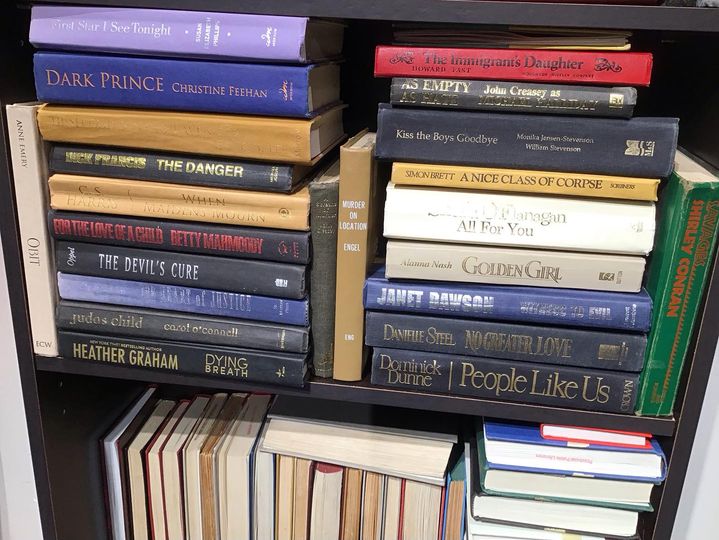
On my first week of residence at the Annex, I brought a bunch of second-hand books that came from the Friends of the Library. I’m not supposed to tell you this, but libraries throw away a lot of books all the time. Books are donated. Some the library already has, some are added to their collection, and some they sell at fundraising book sales. They only have so much room for the leftovers. So I got a random collection of books to use as ballast for my Immersive Book.

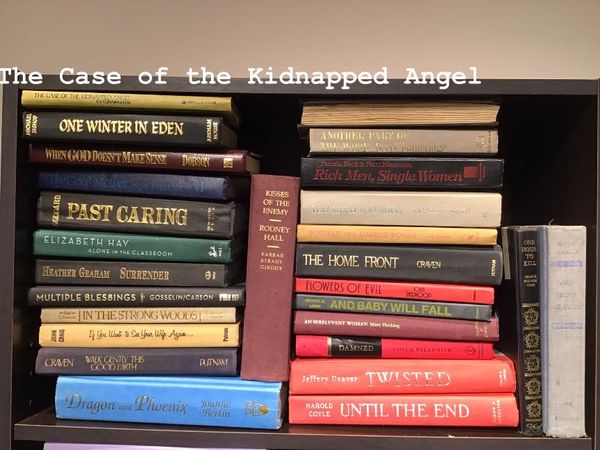
Last week, moving the books into the Annex, I started reading the titles. And then I started sorting them according to interesting titles that related to the subject of my Immersive Book. And then I created the Book Title Poem in the photograph at the top of this blog. I’ve typed it out and pasted it below.

To me this poem is talking about the abuse that is subtext, and the child murder that is in the text of the Grimm’s fairytale, “The Juniper Tree.” I’m not sure if “Book Title Poems” are a thing or not. I know that I’m not a poet. I just want to turn this story around in my head, look at it from different directions, using different media, and then I want to illustrate it, or to comment on it. Because that’s my job as a visual artist. I create art that makes you look at the world differently, that helps you see things you didn’t see before. And that’s what I’m doing in this residency, with my Immersive Book.

–Jennifer Morgan

The Case of the Kidnapped Angel

I.

One winter in Eden,
When God doesn’t make sense,
The Good Mother
Alone in the classroom,
Surrender
Multiple blessings
In the strong woods.
“If you want to see your wife again…
Walk gently this good earth,
Dragon and Phoenix.”

Kisses of the Enemy,
Another part of the wood,
Rich men, single women,
Too much too soon.
Portrait of a married woman:
The home front flowers of evil
And Baby will fall.
An irrelevant woman,
Damned,
Twisted until the End.

One hour to kill
Fire from Heaven.

II. Obit.

First star I see tonight,
Dark Prince,
The second son of Heaven.
The danger
When maidens mourn
For the love of a child.
The Devil’s cure,
The heart of justice,
Judas child,
Dying breath.

A scream of murder,
Murder on location.

The immigrant’s daughter,
As empty as hate,
Kiss the boys goodbye.
A nice class of corpse,
Sheila O’Flanagan,
All for you,
Golden Girl,
Witness to Evil.
No greater love
People like us,
(Savages.)